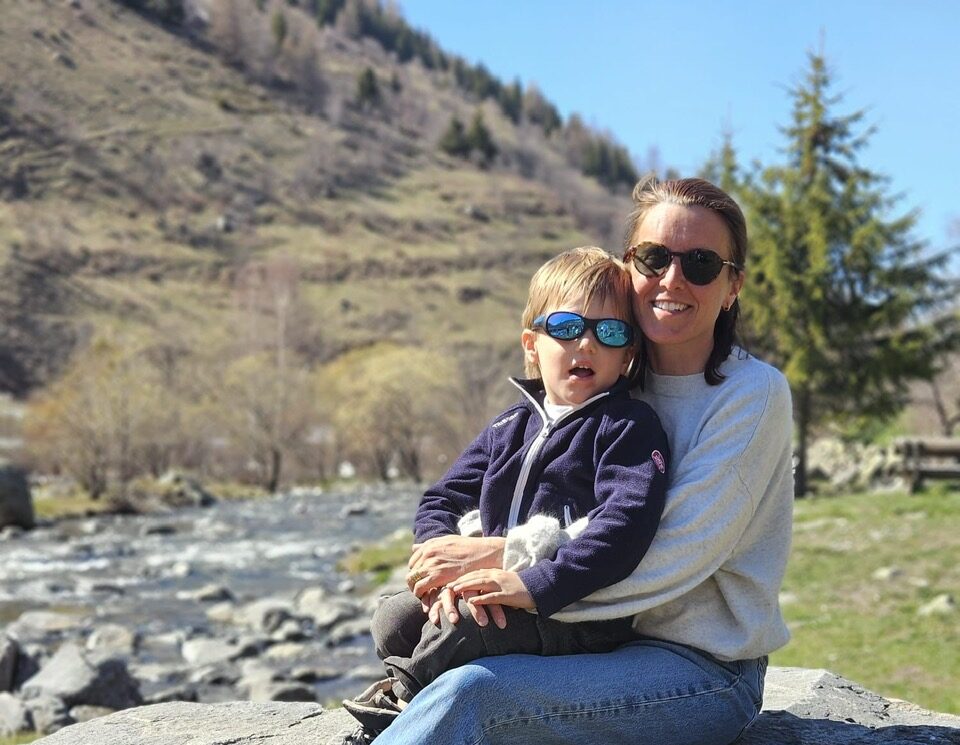
When Hélène Cossée de Maulde talks about her son, her words are filled with infinite tenderness.
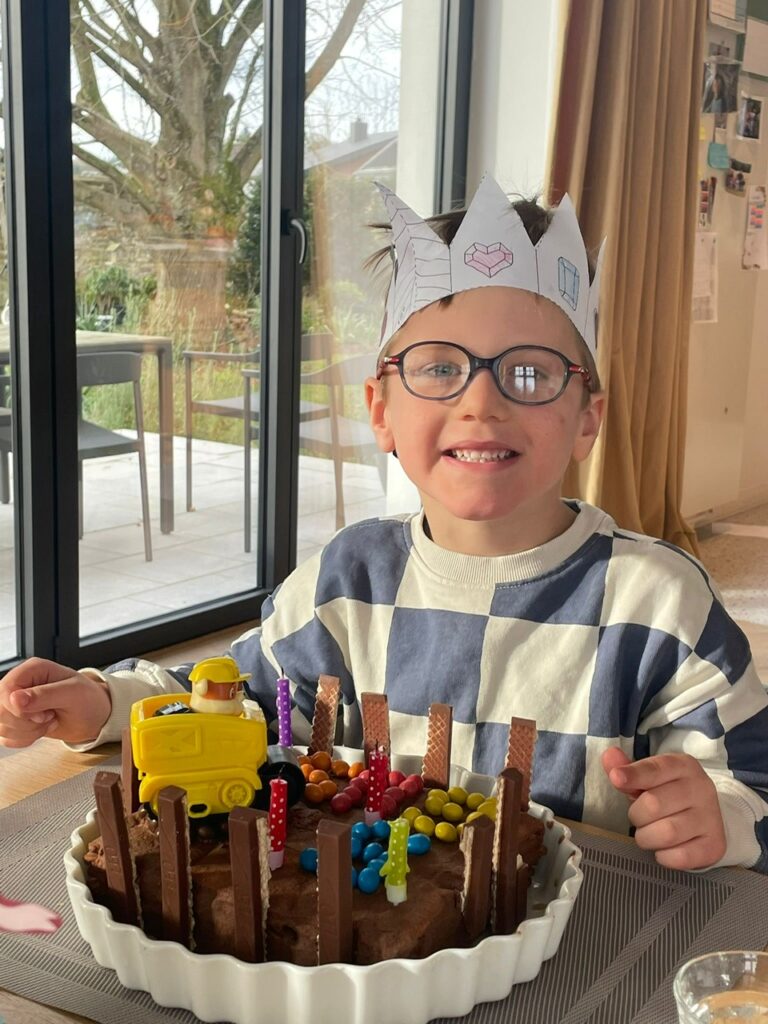
Trained as a psychomotor therapist and massage practitioner, she nevertheless chooses to introduce herself above all as « Gus’s mum. » And Gus is a bright little boy.
A joyful child, deeply sociable, always ready to comfort another child in the playground. A little boy who loves playing outside, digging in the garden, following his older brothers and sister everywhere, pulling funny faces to spark bursts of laughter, and giving hugs all day long. « He is incredibly empathetic. When a child gets hurt, he’s always the first to go over, » his mother says.
An “invisible” condition
When you meet him in the street, nothing suggests that he carries an extremely rare genetic condition. And that is precisely what sometimes makes things even more confusing.
Gus shows almost no visible physical traits linked to his disability. No obvious signs. No marked particularities. Only a very mild strabismus. Then people speak to him, ask him questions, expect an answer. And there is silence. Because Gus understands a great deal. But words, themselves, remain stuck somewhere.
Even during her pregnancy, Hélène felt that “something wasn’t right.” A deep intuition, hard to explain. At the five-month ultrasound, doctors discovered that the baby had only one kidney. She was offered an amniocentesis. She refused. Not out of denial, but because she already knew she would welcome this child whatever happened. “I knew I wouldn’t have been able to end this pregnancy. So I told myself: we’ll deal with whatever comes.”
At birth, however, the first genetic tests came back negative. Doctors were reassuring. But very quickly, something felt off. Gus suffered from severe reflux. He would projectile vomit, day and night. He barely gained weight. Hélène went from specialist to specialist, searching, observing, worrying. Then developmental delays appeared. Gus walked at 23 months. Each milestone came later. Words did not come.
What followed were endless medical investigations: ENT assessments, EEGs, neurological tests, genetic panels… And always the waiting. Months between appointments. Months to obtain results. Months suspended between hope and anxiety. “Each time, we waited five or six months for an answer or an appointment. And in the meantime, you keep wondering what is happening to your child. It’s unbearable.”
The diagnosis finally came in April 2024, when Gus was three years old. That day, Hélène was alone at the hospital with her son. Her husband, Lorenzo del Marmol, was not present, as it was supposed to be a routine check-up. The paediatric neurologist told her they had found “something.” She gave her the diagnosis, the name of the condition, and tried to explain what it meant. But Hélène remembers above all an overwhelming fog. “She explains what it is… but my brain doesn’t register everything.” A few words remained suspended, impossible to absorb at that moment. There was no real support, no psychologist, no time to process it.“I left the appointment, sat in my car… and broke down.” What was most painful was not only the diagnosis. It was the loneliness that came with it.
A few weeks later, Hélène was fortunately able to see a geneticist at the Institute of Pathology and Genetics in Gosselies (Charleroi), who provided more information. A scientific name: KAT6A syndrome. A very rare genetic condition, also known as Arboleda-Tham syndrome, only discovered a few years ago, with barely 600 cases reported worldwide.
A “photocopier glitch”
This time, someone really took the time. A two-hour consultation. Human, simple, understandable explanations. “She told me that, basically, in the photocopier, a letter was missing in Gus’s genetic code.” This image is one Hélène will never forget.
The geneticist also explained that Gus is likely mildly affected because the mutation is located at the beginning of the gene. An essential nuance. A relative relief. Because with this condition, some children are much more severely affected. But even “mildly affected,” everything changes…
Today, Gus is progressing. Slowly, but steadily. He is beginning to put together a few words, recognises the letters of his name: G-U-S, and moves forward at his own pace. And above all, he remains deeply happy. “When he comes home from school, I can’t ask him how his day was like I do with other children. I never really get his story. Only fragments. And that… is very painful.”
Like all parents facing a rare disease, Hélène continues to search. She reads scientific studies, spends entire nights online, joins patient associations in France, exchanges with other parents, and created a WhatsApp group with a few friends whose children also have “a little something extra.” She tries to understand what lies ahead for her son. But she has learned to focus on small victories. “If I start projecting myself to when he’s 18 or imagining the whole future, it becomes too heavy. So I try to look at today’s progress.”
Over time, Hélène has also become aware of a more difficult reality: research that sometimes moves too slowly in the face of families’ urgent needs. Data can remain siloed, collaboration between researchers is not always fluid, and scientific or financial constraints can sometimes slow down the sharing of information that is nevertheless essential to advancing knowledge. “Sometimes, it feels like children’s futures come after scientific egos. And that’s terrible when you’re a parent.”
Supporting research is not only funding laboratories
This is precisely where the GENeHOPE Fund makes sense. Because supporting genetic research is not only about funding laboratories. It is about accelerating diagnoses, fostering collaboration between researchers, encouraging data sharing, avoiding years of medical wandering for families, and above all, offering hope. “If a researcher hadn’t taken an interest in this gene a few years ago, my son’s syndrome wouldn’t even officially exist today.”
For Hélène, sharing her story today is part of a process of acceptance. For a long time, she did not even dare to pronounce the name of the condition around her, out of fear of labels, of others’ gaze, and of the difficulty of accepting the word “disability” for such a lively, affectionate, radiant little boy. But she now knows that speaking out is essential.
Because behind every rare disease, there is a family waiting for answers.
Because behind every scientific breakthrough, there is a child.
And because behind every child like Gus, there are parents who keep hoping.
Sometimes even laughing to keep going. On April 1st last year, Hélène even sent a message to her whole family announcing, as a joke, that Gus had “started speaking.” A tender and heartbreaking joke at the same time. Behind the humour lay that immense, quiet, stubborn dream shared by so many parents of children with language disorders: to one day hear their child simply tell them about their day.